Brain Out 2 Level 174
📝 Walkthrough
Overview
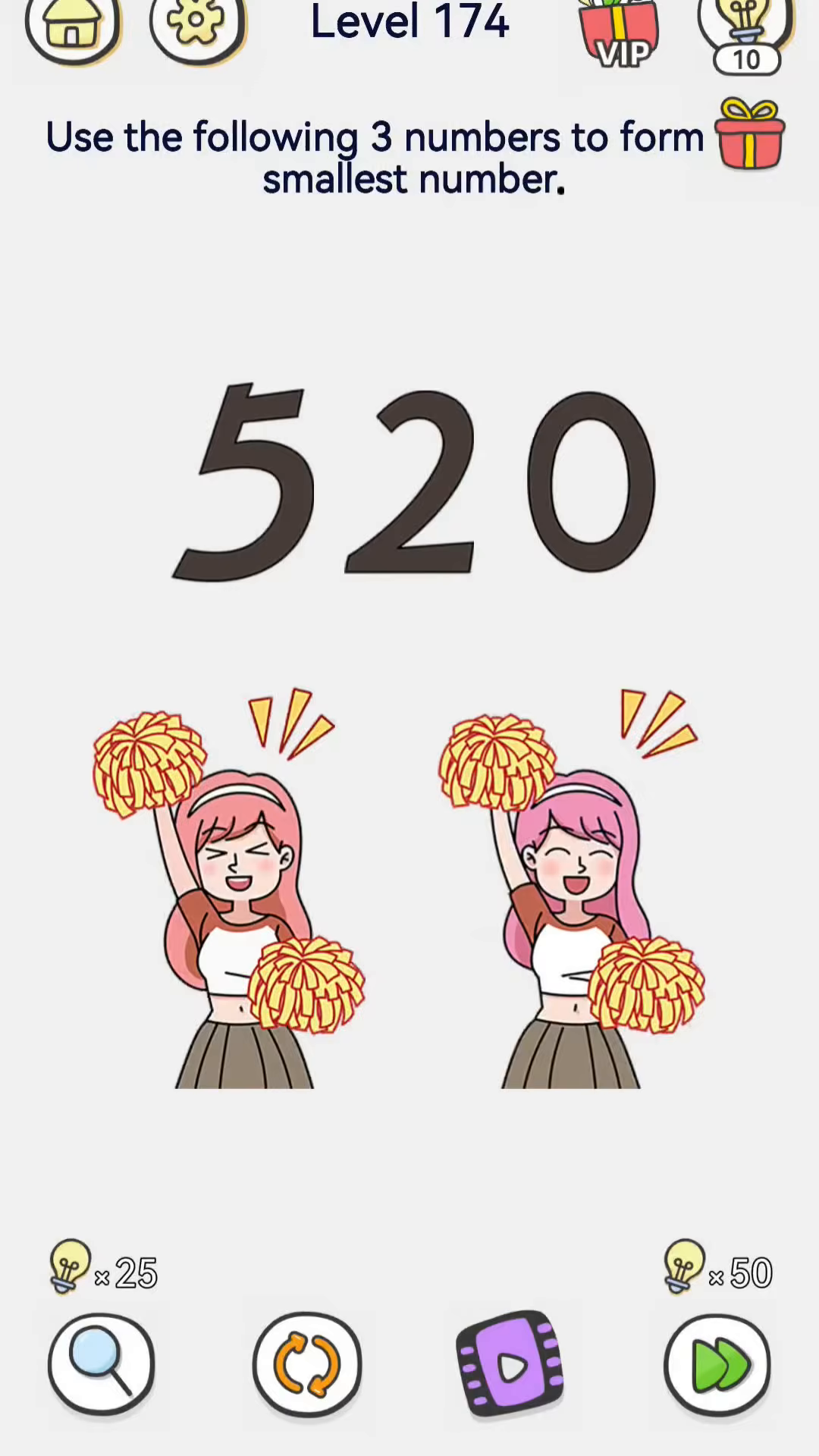
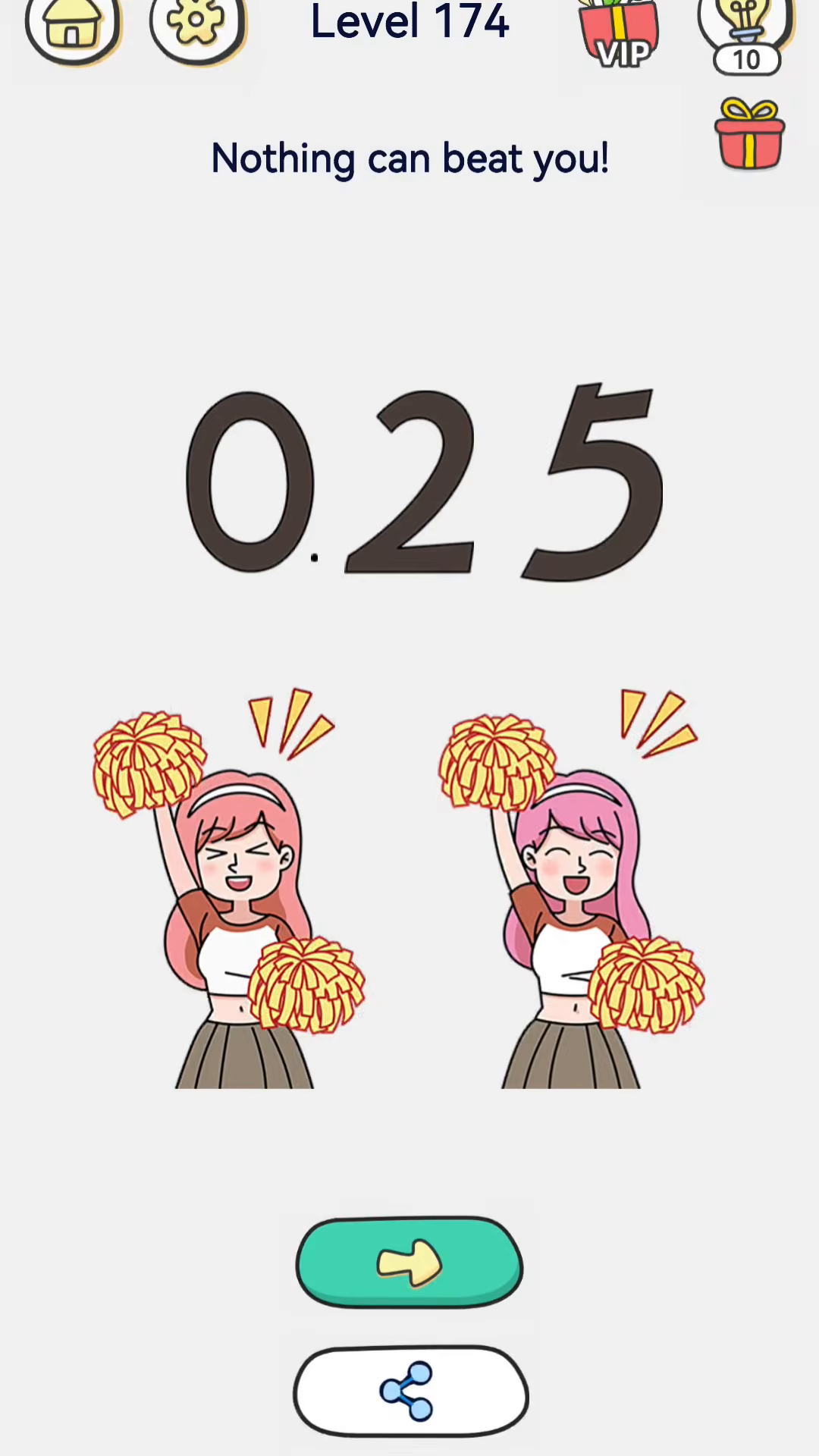
The screen shows the digits 5, 2, and 0 and asks you to form the smallest number from them. Two cheerleaders celebrate below. The solved frame shows the number "0.25" with the message "Nothing can beat you!". The trick is that a plain three-digit arrangement like 205 or 250 is not the smallest — you must insert a decimal point.
- Difficulty: Easy
- Estimated moves: 2–3
Step-by-Step Solution
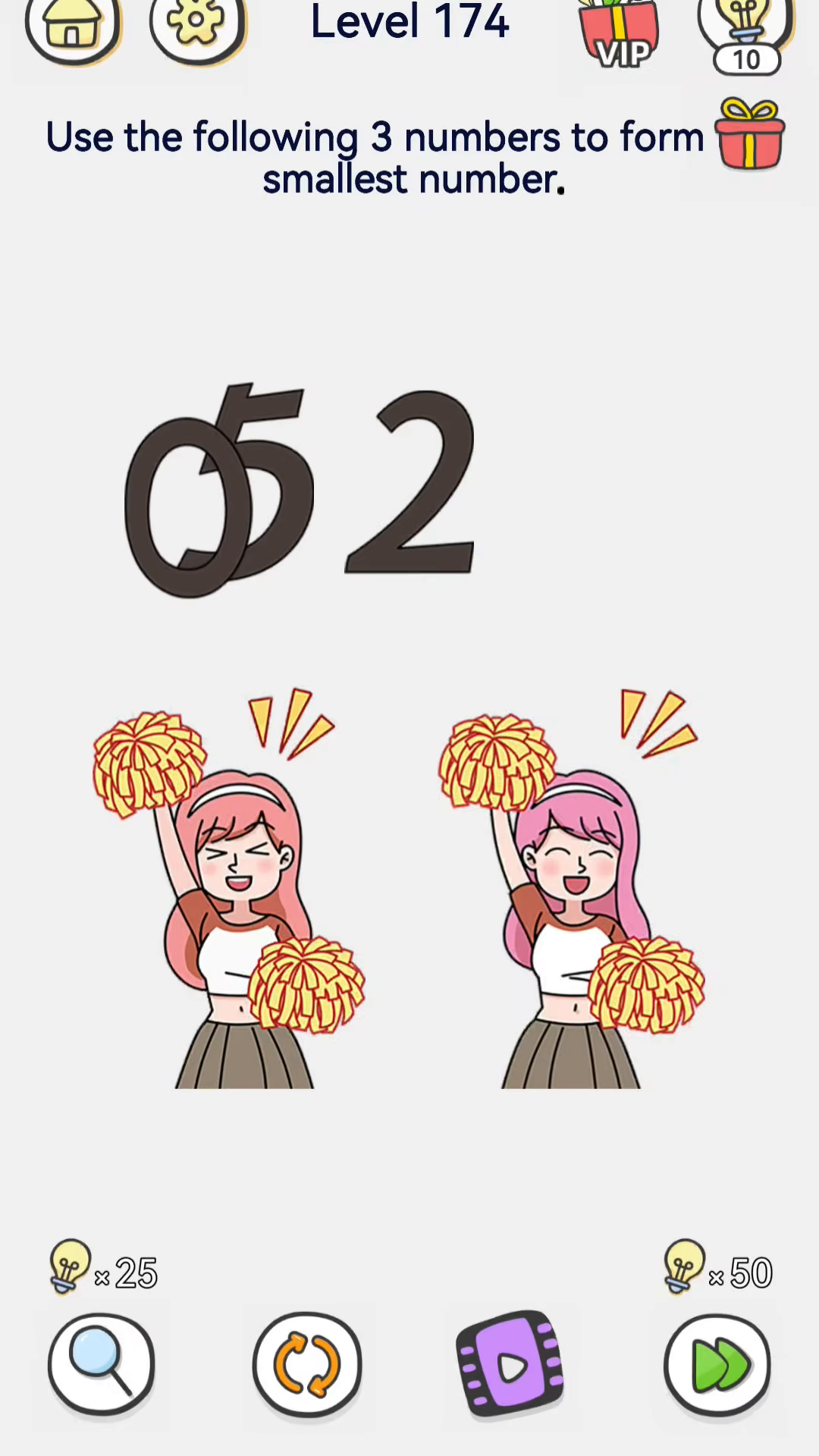
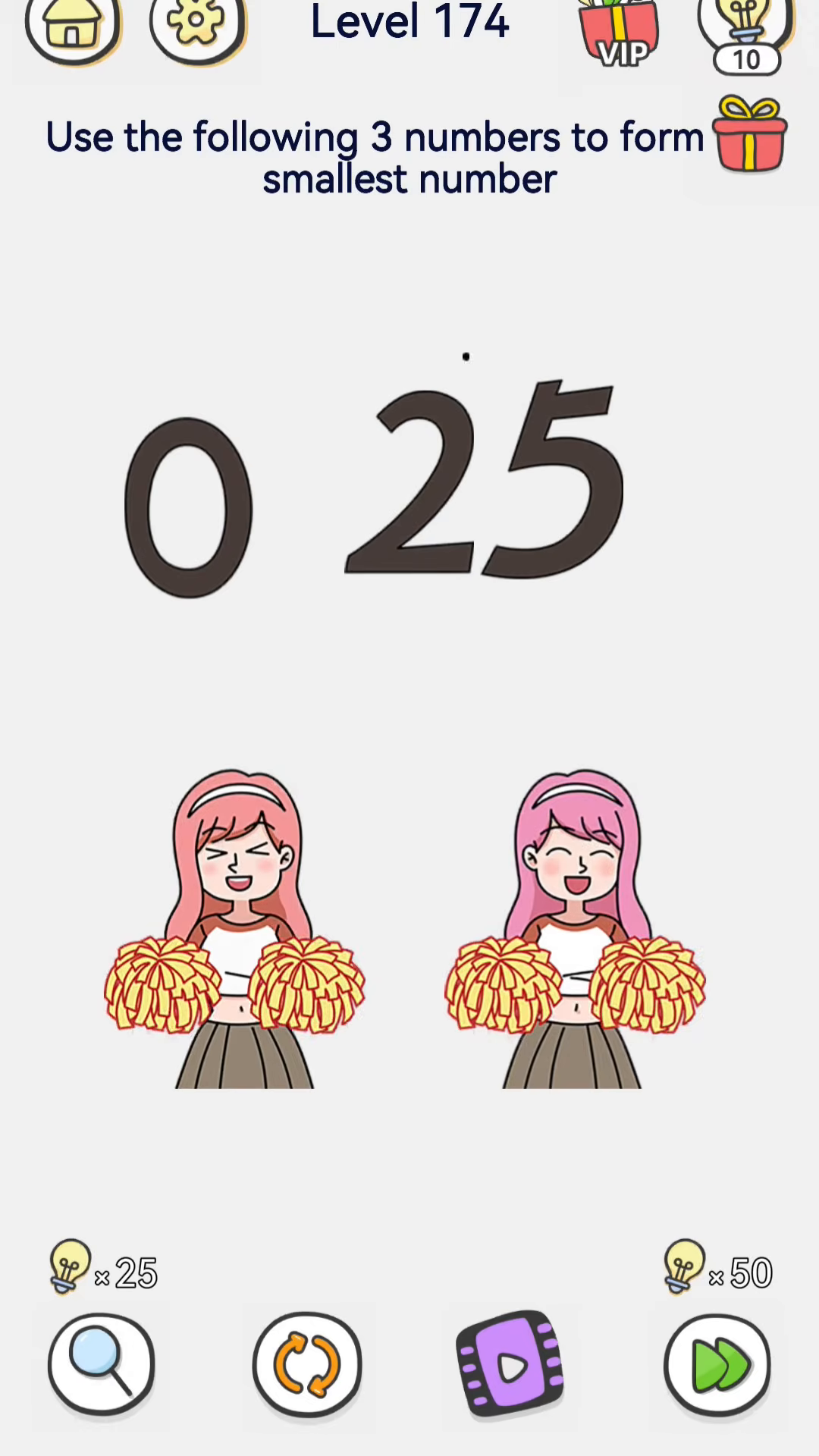
- Arrange the digits. Lay the three digits out so that 0 comes first, followed by 2 and 5, giving the sequence 0, 2, 5.
- Add a decimal point. Insert the decimal point between the 0 and the 2 so the sequence reads 0.25 rather than 025.
- Submit. The level accepts 0.25 as the smallest possible number. The cheerleaders jump and the "Nothing can beat you!" result appears.
- Do not keep rearranging. Any other order or the missing decimal gives a larger value, so 0.25 is the unique correct answer.
Strategy & Reasoning
If you only permute the digits, the smallest plain number is 205 (or treating leading zero, 025 = 25). But the game allows a decimal point. Putting the decimal right after the leading zero yields 0.25, which is smaller than any whole number you can make. The cheerleaders and the celebratory result confirm this is the intended clever answer.
The key realization is that "smallest number" does not have to be an integer. By placing the 0 in the units place and the decimal point immediately after it, the remaining digits become a fractional part, giving a value less than 1. This beats arranging the digits as 025, which just equals 25. The puzzle tests whether you remember that decimals can produce smaller values than any whole number built from the same digits.
Why does the decimal point matter so much? If you treat the problem purely as a rearrangement puzzle, the best you can do with digits 5, 2, 0 is 205, because a number cannot normally start with zero. The game, however, does not require the result to be a whole number. By letting the leading 0 sit in the ones place and putting the decimal right after it, 2 and 5 become the fractional digits, shrinking the value below 1. This is a classic Brain Out trick: the prompt says "smallest number," not "smallest integer," so the decimal point is the missing piece. Trying a minus sign or stacking the digits fails, which is how you know 0.25 is the only intended answer.
Tips & Common Mistakes
- Mistake: ordering digits only. Simply arranging them as 025 and submitting is wrong; you need the decimal point.
- Tip: The decimal point goes right after the 0, not after the 2 or 5.
- Mistake: overthinking. Do not try to use negative signs or exponents; the accepted answer here is 0.25.
- Note: The cheerleaders react only when the value is genuinely the smallest possible.
Key Frames