Brain Out 2 Level 136
📝 Walkthrough
Overview
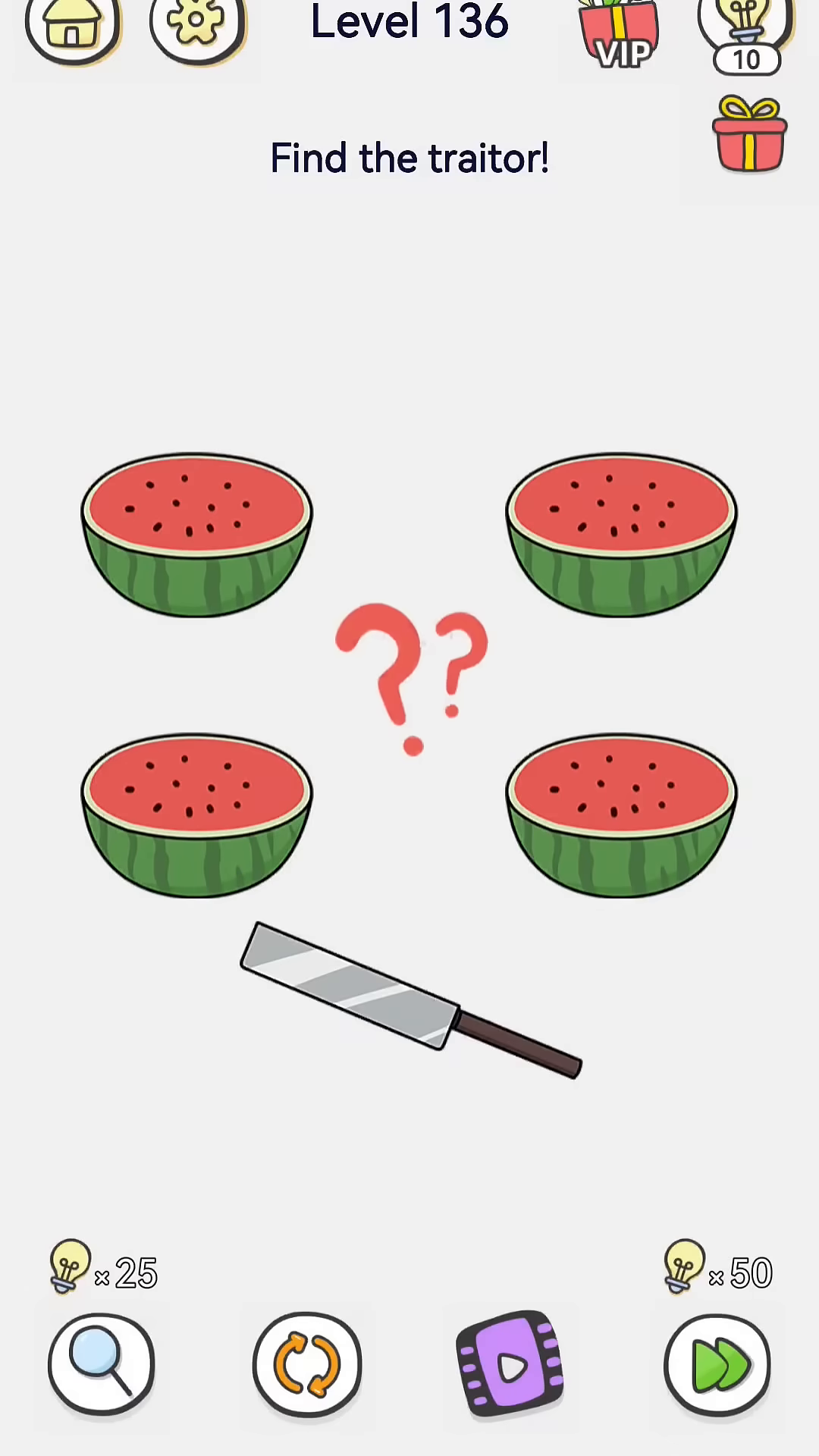
Level 136 presents the classic "Find the traitor!" challenge. The screen shows a small collection of watermelon slices arranged on a white background, and one of those slices is not actually watermelon at all — it has been designed to look like a piece of cake. The goal is simple to state but tricky to spot: examine every slice carefully, identify the one that does not belong, and tap it to expose the imposter. The core mechanic is visual pattern recognition, and the entire puzzle can be solved in a single tap once you know what to look for.
- Difficulty: Easy
- Estimated moves: 1
Step-by-Step Solution
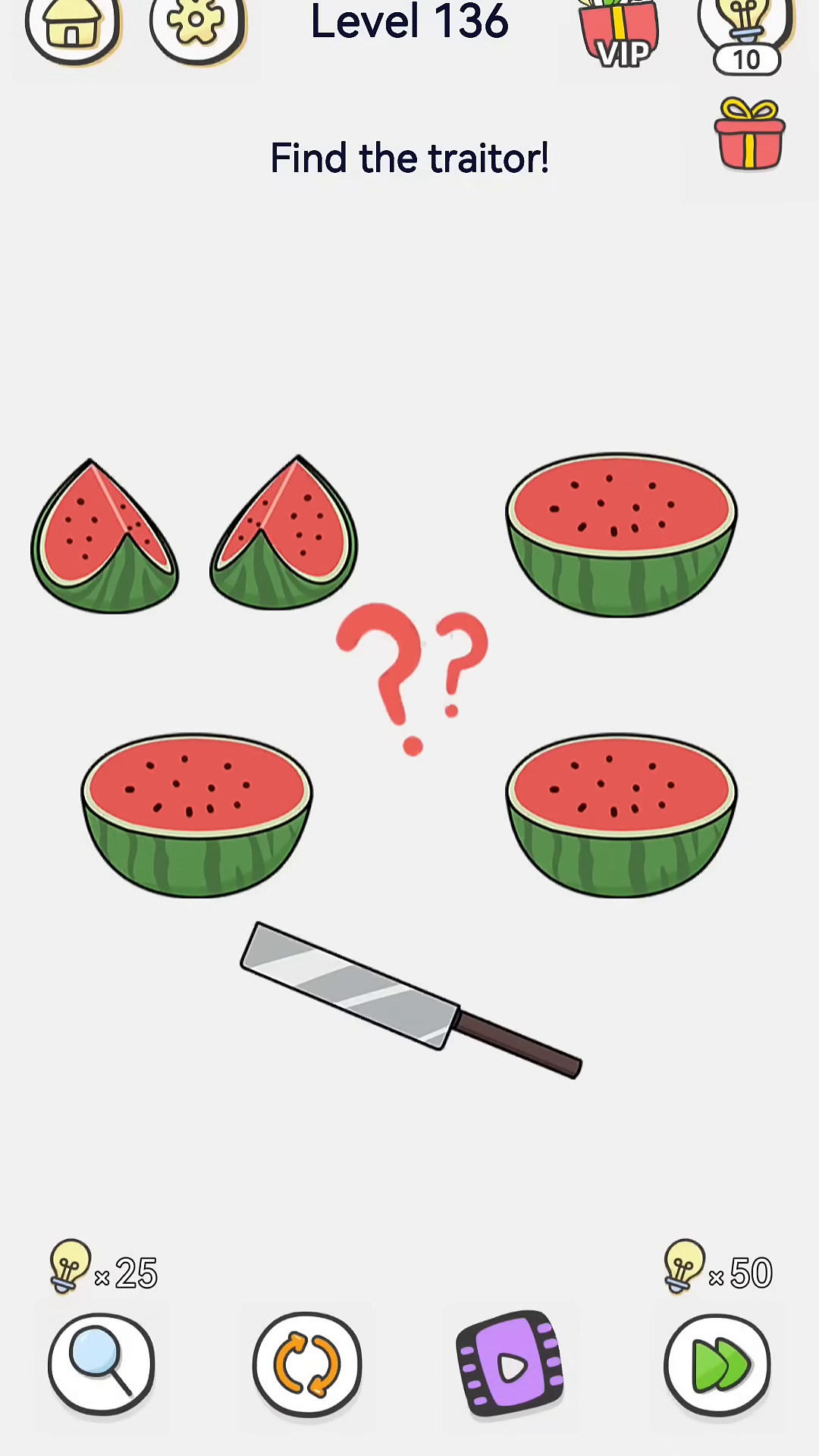
- Take a full look at the board. When the level opens, four watermelon slices are laid out in front of you in a two-by-two arrangement. Do not tap anything yet — the traitor can only be found by careful comparison, and the slices are deliberately drawn to look nearly identical at first glance.
- Study the rind pattern of every slice. All genuine watermelon pieces share the same dark green rind with lighter stripe markings. Move your attention from slice to slice and ask yourself whether every piece shows the same familiar striped rind, or whether one of them uses a different pattern altogether.
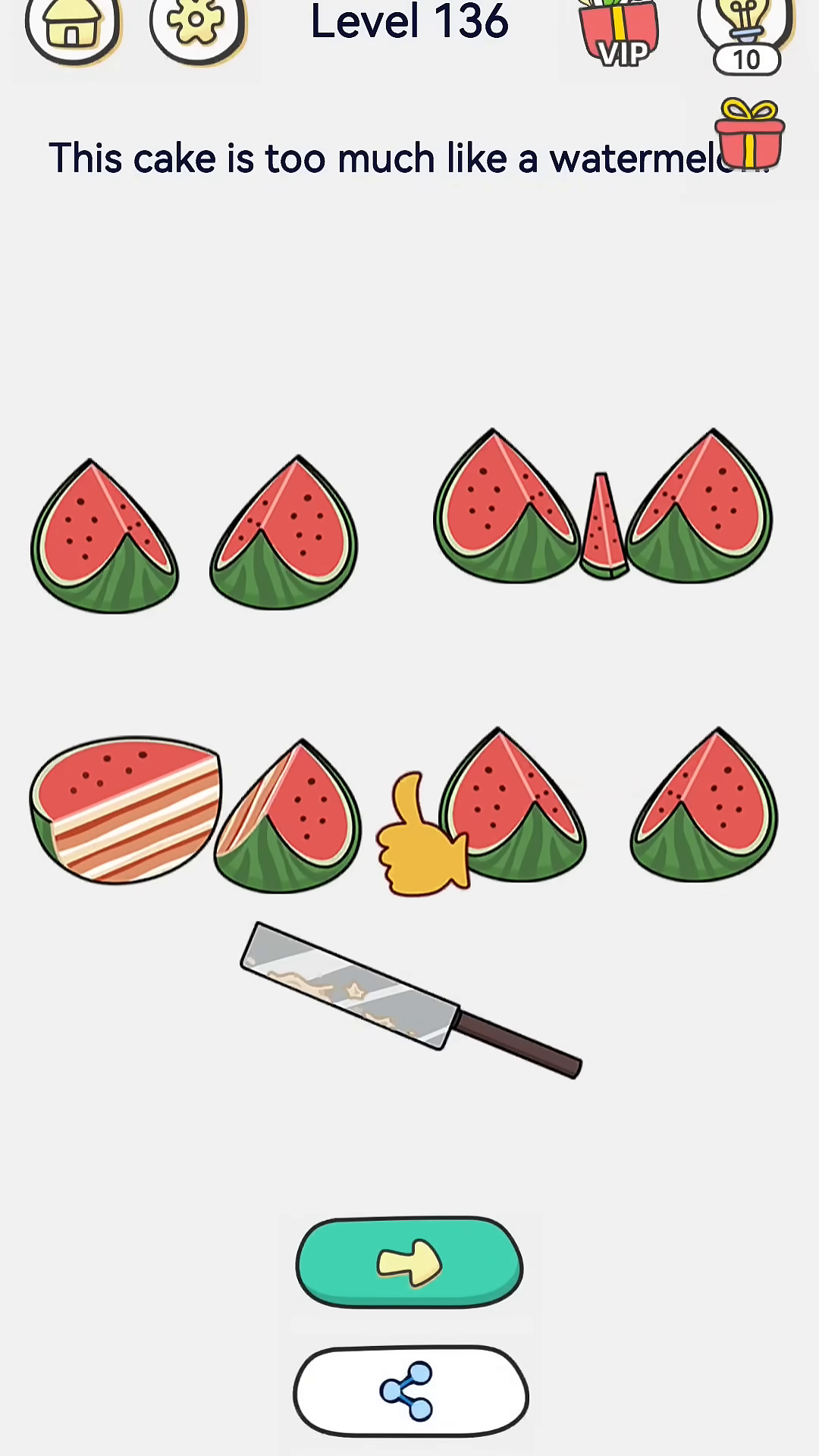
- Compare the flesh texture and colour. Real watermelon flesh is bright red or pink with a waterlogged, juicy look, and it always carries the small black seeds that give watermelon its signature appearance. The traitor, however, is a cake pretending to be watermelon: its inner texture is denser, sponge-like, and it lacks the scattered black seeds that the other slices all have.
- Let the clue text guide you. The level's hint reads "This cake is too much like a watermelon..." — this is your confirmation that the traitor is a piece of cake disguised as a fruit slice. Search for the slice whose inner pattern looks baked rather than juicy.
- Tap the cake-textured slice. Once you have found the slice whose flesh resembles cake instead of watermelon, tap it directly. If you have chosen correctly, the game immediately confirms the answer with a thumbs-up reaction and the level is cleared.
- Confirm the solution. After your tap, the winning slice is highlighted and the puzzle advances. No further moves are needed — this level is finished in that single correct selection.
Strategy & Reasoning
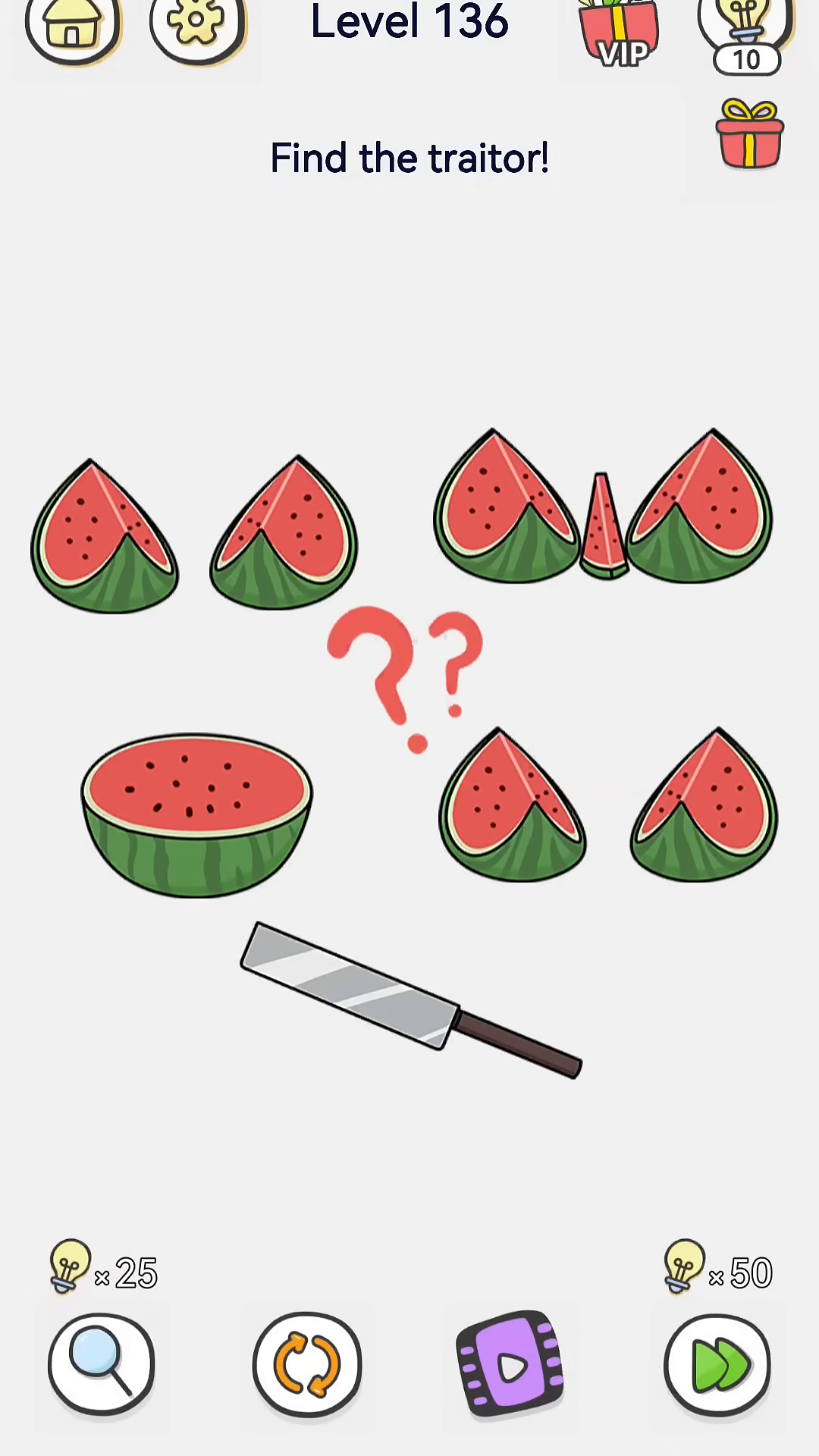
This level is a pure "odd one out" puzzle, and the winning strategy is to compare the slices along dimensions where a cake cannot imitate a watermelon perfectly. Shape and outline are almost identical across all four pieces, so judging by silhouette alone will not help you. The decisive differences are the internal details: the number and placement of seeds, the evenness of the flesh, and the texture that the illustration uses inside each slice.
The traitor is the piece whose inside is drawn as cake — with a smooth, layered, baked look and no watermelon seeds. Everything else about the puzzle is a decoy: the slices are rearranged, the knife is present, and the question mark icons draw your eye to the wrong places. By filtering for the seed-and-texture difference first, you eliminate the decoys in one pass and the answer becomes obvious.
There is no benefit to tapping randomly or trying slices one by one — a wrong tap does not reduce the difficulty and simply costs time. The observation-only approach is also exactly what the game is testing: whether you can ignore the superficial similarity of the four pieces and focus on the one feature that separates them.
Tips & Common Mistakes
- Mistake: choosing by position. Some players tap the slice in the top-right corner because it "feels" different, or they tap the largest-looking piece. Position and size are not the answer — the traitor is the one with the wrong internal texture, wherever it sits on the board.
- Mistake: ignoring the clue sentence. The prompt "This cake is too much like a watermelon" is not decoration; it tells you the imposter is cake. Players who tap based purely on colour often pick a piece that is merely slightly paler, and fail. Read the hint and look for baked texture, not subtle colour shifts.
- Mistake: confusing the knife or the question marks as targets. The knife at the bottom and the red question marks drawn on the slices are part of the scene dressing, not interactive clues. The only action that matters is tapping the cake slice. If your first pick gets a wrong reaction, do not repeat the same choice — re-check which slice actually lacks the watermelon seeds.
Key Frames